
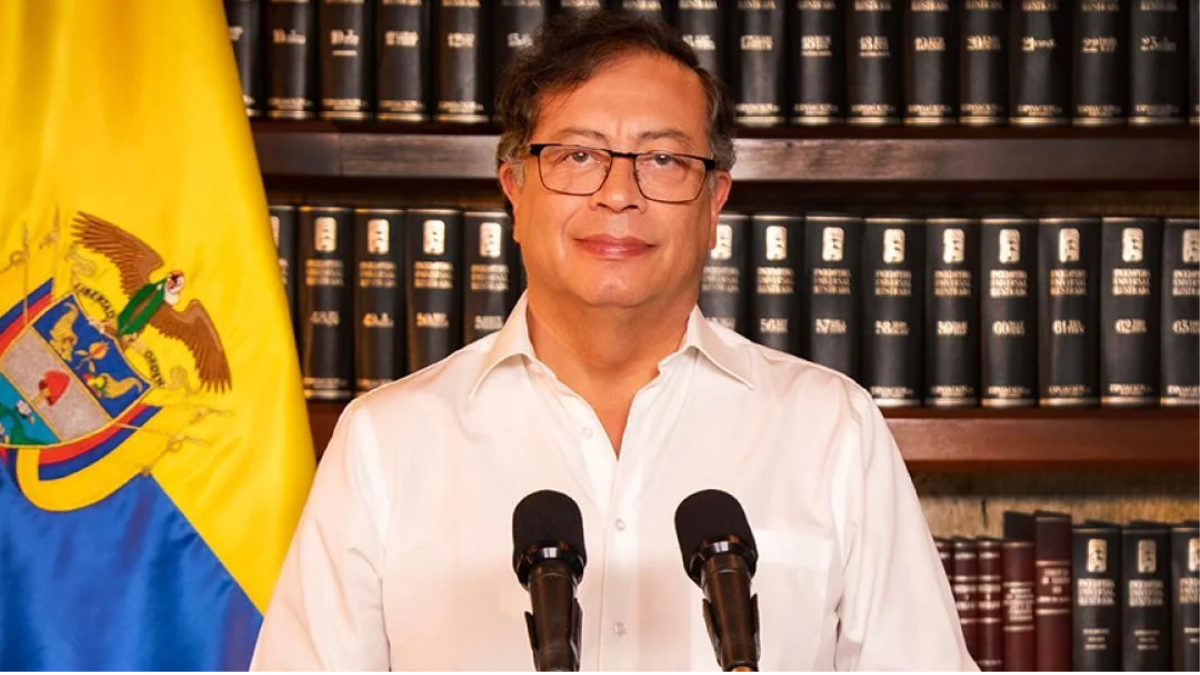
Gustavo Petro Heil Hitler
The keyword Gustavo Petro Heil Hitler became a subject of international attention in June 2026 after Colombian President Gustavo Petro published the words “Heil Hitler” on his official X account. The post immediately attracted criticism because the expression is historically associated with Adolf Hitler and Nazi Germany.
The incident was connected to a political debate in Colombia involving conservative presidential candidate Abelardo de la Espriella. Petro later explained that he intended to criticize what he considered fascist language in an opinion article, rather than express support for Nazi ideology.
However, his explanation did not prevent criticism from Israeli officials, Latin American lawmakers, and social media users. The controversy also raised questions about historical references, political communication, and the responsibility of public officials when using social media.
Understanding the incident requires looking beyond the original two-word post. Its political background, historical meaning, international reactions, and Petro’s subsequent explanation all help explain why it became a major news story.
Who Is Gustavo Petro?
Gustavo Petro is a Colombian politician who served as president of Colombia from August 2022 to August 2026. He became internationally recognized for his left-wing political positions, social reform proposals, environmental policies, and criticism of economic inequality.
Before becoming president, Petro held several important political positions. He served as a senator, mayor of Bogotá, and member of Colombia’s House of Representatives.
His political career has included debates about economic development, public security, social inequality, environmental protection, and international relations.
Petro also became known for his frequent use of social media to communicate directly with the public. His posts on X regularly attracted attention from supporters, political opponents, journalists, and international observers.
The June 2026 controversy occurred during the final weeks of his presidential term, making the incident particularly significant in Colombia’s political environment.
What Happened in the Gustavo Petro Heil Hitler Controversy?
The controversy began on June 7, 2026, when Petro published the expression “Heil Hitler” on X.
His post was a response to a political discussion involving an opinion article by Colombian commentator Felipe Zuleta Lleras. The article supported the political position of conservative presidential candidate Abelardo de la Espriella.
One of the central ideas highlighted in the article concerned order, authority, and economic freedom in Colombia.
Petro responded with the two-word expression associated with Nazi Germany.
The post quickly attracted attention because “Heil Hitler” is not an ordinary political expression. It was historically used as a greeting and declaration of loyalty to Adolf Hitler during the Nazi regime.
Many readers questioned why a national leader would use such language in a discussion about a democratic election.
Petro subsequently defended his response, explaining that he intended to criticize what he considered fascist language in the article.
The explanation provided additional context, but it did not eliminate the criticism surrounding his choice of words. Jewish Telegraphic Agency+1
Why Did Gustavo Petro Write Heil Hitler on X?
To understand Petro’s response, it is important to examine the political discussion that preceded it.
The opinion article supported Abelardo de la Espriella, a conservative lawyer and presidential candidate who promoted stronger public security, authority, and economic freedom.
Petro interpreted the language used in the article as reflecting ideas he considered fascist.
His response was intended as a political criticism rather than an expression of admiration for Hitler, according to his subsequent explanation.
However, using the Nazi slogan created a serious communication problem.
A reader who saw only the original post could easily understand why it attracted criticism. The phrase has an established historical meaning that cannot be separated from its association with Nazi Germany.
Petro later acknowledged that he had failed to provide sufficient context.
This distinction is essential when reporting the incident: his stated intention was to criticize political language, but the wording he selected was widely considered inappropriate.
Who Is Abelardo de la Espriella?
Abelardo de la Espriella is a Colombian lawyer and political figure who became an important candidate in the country’s 2026 presidential election.
He represented a conservative political alternative to the left-wing political movement associated with Petro.
His political positions included stronger public security, greater emphasis on government authority, and economic freedom.
De la Espriella also supported restoring diplomatic relations with Israel, which had been severed under Petro’s government in 2024.
The opinion article that triggered Petro’s response supported de la Espriella’s political approach.
This background explains why the controversy was connected to Colombia’s presidential election. It was not simply a discussion about historical language; it was also part of a larger disagreement about the country’s political direction.
The election campaign had already become highly polarized, with competing political groups presenting different approaches to security, economic policy, and international relations. Jewish Telegraphic Agency+1
What Does Heil Hitler Mean?
“Heil Hitler” is a German expression commonly translated as “Hail Hitler.”
It became a widely recognized greeting and expression of loyalty during Adolf Hitler’s rule in Germany.
The Nazi regime used the phrase as part of its political culture, public ceremonies, propaganda, and displays of allegiance to the Nazi leader.
The expression is closely connected to the history of National Socialism and the dictatorship established in Germany between 1933 and 1945.
Its historical significance is particularly serious because the Nazi regime was responsible for systematic persecution, mass murder, and the Holocaust.
The Holocaust involved the murder of approximately six million Jewish people, alongside the persecution and killing of millions of other victims.
Today, the expression is widely recognized as a symbol of Nazi ideology and extremist political movements.
The United States Holocaust Memorial Museum provides historical information about Nazi propaganda, political symbolism, persecution, and the Holocaust. United States Holocaust Memorial Museum+1
Why Did the Post Attract So Much Criticism?
The controversy was not limited to the wording of a single social media post.
It involved historical sensitivity, political responsibility, international diplomacy, and the growing use of provocative language in political discussions.
Several factors explain the strong reaction.
Historical significance: The phrase is directly associated with Adolf Hitler and a regime responsible for genocide and widespread persecution.
Presidential responsibility: Statements made by national leaders receive international attention and can influence diplomatic relationships.
Political polarization: Using Nazi references to criticize political opponents can make disagreements more hostile.
Holocaust remembrance: Many people consider the use of Nazi slogans in ordinary political arguments disrespectful to the victims of the Holocaust.
International consequences: The incident attracted attention from Israeli representatives and lawmakers across Latin America.
These concerns explain why the controversy became larger than an ordinary disagreement between Colombian politicians.
How Did Israel React to Gustavo Petro’s Statement?
The post attracted strong criticism from Israeli officials.
Danny Danon, Israel’s ambassador to the United Nations, publicly challenged Petro’s use of the Nazi slogan.
Danon argued that there were limits that political leaders should not cross when communicating with the public.
He called on Petro to apologize before his scheduled appearance at the United Nations Security Council on June 10, 2026.
Israel’s Foreign Ministry also criticized the post, describing it as a serious failure of moral judgment.
The reaction was significant because Petro was preparing to preside over a meeting of an important international organization.
The criticism therefore developed alongside an important diplomatic event.
The controversy also took place during an already difficult period in relations between Colombia and Israel.
The responses from Israeli representatives demonstrated how a domestic political argument could become an international diplomatic issue. Jewish Telegraphic Agency+1
Why Did 24 Latin American Lawmakers Condemn the Post?
The criticism extended beyond Israel.
On June 8 and 9, 2026, 24 lawmakers representing 14 Latin American countries supported a statement condemning the use of Nazi references in political debate.
The statement argued that references to Nazism should not become a rhetorical tool for discrediting political or ideological opponents.
It also emphasized that democratic leaders have a responsibility to encourage respectful public discussion and recognize the historical importance of their words.
The participating lawmakers represented countries including:
- Argentina
- Brazil
- Chile
- Colombia
- Costa Rica
- Ecuador
- Guatemala
- Honduras
- Mexico
- Panama
- Paraguay
- Peru
- Dominican Republic
- Uruguay
The declaration was organized through the Coalition of Latin American Legislators Against Antisemitism.
Its central concern was that Nazi terminology should not be casually introduced into political disagreements.
The statement demonstrated that the incident had become a regional political controversy rather than simply a dispute between Petro and his opponents. Jewish Telegraphic Agency+1
What Did Gustavo Petro Say in His Defense?
Petro defended his original post by explaining that he intended to criticize what he considered fascist language in the opinion article.
However, the controversy continued after his explanation.
On June 10, 2026, Petro addressed the issue during his appearance at the United Nations Security Council in New York.
According to a Reuters Connect video report, he described his social media post as “stupid” and acknowledged that he had made communication mistakes.
He explained that the message had been published in the context of a domestic political discussion but had circulated internationally without the additional explanation he believed was necessary.
He also rejected the idea that he intended to diminish the Holocaust, describing the historical tragedy as an example that should never be repeated.
His remarks were important because they showed that he recognized the problems created by his original wording.
However, acknowledging a communication mistake and issuing a formal apology are not necessarily the same thing. The available reporting establishes his comments about the post, but should not be interpreted as proof of a comprehensive formal apology to everyone offended by it. Reuters Connect+1
What Happened During Petro’s United Nations Appearance?
The controversy received additional attention on June 10, when Petro appeared before the United Nations Security Council in New York.
His appearance was particularly important because Colombia held a non-permanent seat on the Security Council and Petro was presiding over a meeting.
During his remarks, he discussed international conflicts, migration, racism, and the historical dangers of Nazi ideology.
He again referred to the Nazi era while criticizing policies and attitudes that he considered discriminatory.
The meeting attracted further attention when the United States delegation left its seat during part of his remarks. According to reporting by EFE published through Swissinfo, Petro criticized the departure and described it as regrettable.
The diplomatic exchanges demonstrated how the controversy had expanded beyond the original social media post.
Instead of remaining a domestic political disagreement, it became part of a wider discussion involving international relations, historical comparisons, and the responsibilities of governments at the United Nations. SWI swissinfo.ch+1
What Was the Relationship Between Gustavo Petro and Israel?
The controversy also needs to be understood within the context of Colombia’s relationship with Israel.
During his presidency, Petro became a vocal critic of Israel’s military operations in Gaza.
He repeatedly expressed concern about civilian casualties and the humanitarian situation in the Palestinian territory.
In May 2024, Colombia severed diplomatic relations with Israel, following Petro’s criticism of the Israeli government’s military campaign.
Israel rejected allegations made against it by Petro and criticized his statements.
These disagreements created a difficult diplomatic environment between the two countries.
The June 2026 incident added another source of tension because the expression used by Petro was closely associated with Nazi Germany and the Holocaust.
Consequently, Israeli officials viewed the post as particularly inappropriate.
The controversy therefore involved both the historical meaning of the expression and the existing political disagreements between the two governments. Jewish Telegraphic Agency+1
How Did Social Media React to the Controversy?
Social media played an important role in spreading the Gustavo Petro Heil Hitler controversy.
The original post attracted attention from people with different political views, national backgrounds, and historical perspectives.
Some users criticized Petro for using a Nazi slogan in a political discussion. Others defended his explanation that he was attempting to criticize fascist ideas rather than support Hitler.
The disagreement showed how the same message can be interpreted differently depending on the reader’s understanding of its context.
A June 15, 2026, analysis published by Blue Square Alliance reported that Petro’s post received approximately 36.3 million views between June 7 and June 12.
The organization also examined 3,550 replies and reported the following distribution:
| Reaction in the analyzed sample | Percentage |
|---|---|
| Condemned the post | 63% |
| Neutral | 17% |
| Supported the post | 21% |
These percentages are from the organization’s particular sample of replies. They should not be treated as a representative survey of the entire Colombian population or all X users.
Nevertheless, the figures illustrate the scale of online discussion surrounding the incident. BSA
Timeline of the Gustavo Petro Heil Hitler Controversy
The following timeline summarizes the major developments reported in June 2026.
| Date | Development |
|---|---|
| June 7, 2026 | Petro publishes “Heil Hitler” on X. |
| June 8, 2026 | Israeli officials and political figures criticize the post. |
| June 8–9, 2026 | 24 lawmakers from 14 Latin American countries support a condemnation statement. |
| June 10, 2026 | Petro addresses the controversy at the UN Security Council and calls his post stupid. |
| June 15, 2026 | Blue Square Alliance publishes its analysis of reactions to the post. |
Jewish Telegraphic Agency+3
What Does This Controversy Tell Us About Political Communication?
The incident provides an important example of the challenges political leaders face when communicating through social media.
Platforms such as X allow politicians to reach large audiences without depending entirely on traditional news organizations.
However, short posts can also create misunderstandings, particularly when they involve sensitive historical subjects.
There are several important lessons from the incident.
Context is important: Readers should understand the discussion surrounding a controversial statement rather than relying only on a screenshot or headline.
Historical language matters: Expressions associated with genocide, dictatorship, and extremist movements carry serious historical meaning.
Political leaders face greater scrutiny: Statements from presidents and other senior officials can influence international perceptions.
Social media spreads information quickly: A controversial message can reach millions of people before its author has an opportunity to explain it.
Political disagreements require careful language: Criticizing authoritarianism or fascism does not require using slogans associated with Nazi Germany.
These lessons apply not only to Petro but also to political leaders and public figures around the world.
The Difference Between Criticizing Fascism and Using Nazi Slogans
One of the central questions raised by the incident is whether a political leader can criticize fascism while using a phrase associated with Nazi ideology.
There is an important distinction between discussing historical extremism and using its symbols as political rhetoric.
Criticism of fascism can be based on historical evidence, political analysis, and specific examples of authoritarian behavior.
For example, a politician can explain why a policy threatens democratic institutions or why particular political statements resemble authoritarian rhetoric.
Using a Nazi slogan instead can distract from the actual argument.
It can also cause unnecessary offense and make it harder for audiences to understand the speaker’s intended message.
Petro’s explanation provided context for his post, but it did not change the historical meaning of the expression.
This is why the incident generated debate even among people who understood that his stated intention was to criticize fascist ideas.
Why Are People Still Searching for Gustavo Petro Heil Hitler?
The keyword continues to be relevant to people researching the 2026 controversy.
Searchers may have encountered a headline, social media screenshot, or discussion about Petro and want to understand what actually happened.
Their questions may include:
- Did Gustavo Petro really publish the phrase?
- Why did he use a Nazi slogan?
- Was he supporting Adolf Hitler?
- What did Israel say about the incident?
- Why did Latin American lawmakers criticize him?
- What did Petro say at the United Nations?
- What is the historical meaning of Heil Hitler?
An informative article needs to answer these questions without exaggerating the original event.
It is also important to distinguish confirmed reporting from political opinions and interpretations.
The strongest explanation is one that presents the original post, its political background, Petro’s defense, and the international reactions together.
Conclusion
The Gustavo Petro Heil Hitler controversy began on June 7, 2026, when Colombia’s outgoing president published the Nazi-associated expression on X in response to a political opinion article supporting conservative candidate Abelardo de la Espriella.
Petro explained that he intended to criticize language he considered fascist. However, the expression attracted strong criticism because of its historical association with Adolf Hitler and Nazi Germany.
Israeli officials and 24 Latin American lawmakers from 14 countries condemned the wording. Petro subsequently acknowledged his communication mistake during his June 10 appearance at the United Nations Security Council.
The incident highlighted the importance of historical awareness, responsible political communication, and understanding the context behind viral social media posts.
Ultimately, the controversy was about more than two words. It demonstrated how a short political statement can create international debate when it involves historically sensitive language.
Frequently Asked Questions
Did Gustavo Petro really post Heil Hitler on X?
Yes. On June 7, 2026, Gustavo Petro published the words “Heil Hitler” on his official X account in response to a political discussion involving an opinion article supporting Abelardo de la Espriella.
Why did Gustavo Petro write Heil Hitler?
Petro explained that he intended to criticize what he considered fascist language in the opinion article. He later acknowledged that his message lacked context and described the post as stupid.
Was Gustavo Petro supporting Adolf Hitler?
The available reporting does not establish that Petro intended to express support for Adolf Hitler or Nazi ideology. His explanation was that he was criticizing political language he considered fascist.
Who criticized Gustavo Petro’s statement?
Israeli officials, including United Nations Ambassador Danny Danon, criticized the post. Additionally, 24 lawmakers representing 14 Latin American countries supported a statement condemning the use of Nazi references in political debate.
What does Heil Hitler mean?
“Heil Hitler” is a German expression meaning “Hail Hitler.” It was used as a greeting and expression of loyalty to Adolf Hitler during Nazi Germany.
Did Gustavo Petro apologize for the post?
Petro acknowledged that the post was a communication mistake and called it stupid during his June 10, 2026, appearance at the United Nations. The available reporting does not establish a clear formal apology to everyone offended.
Why did the controversy become international news?
The historical meaning of the phrase, Petro’s position as Colombia’s outgoing president, criticism from Israeli officials, and reactions from Latin American lawmakers helped turn the incident into an international political controversy.





[…] increasingly focuses on clothing that combines comfort, functionality, and personal expression. Parachute jumpsuits fit this approach because they offer a complete outfit without requiring several separate clothing […]